03
Independent Research / Biotechnology
CRISPR/Cas9 for Polycystic Kidney Disease
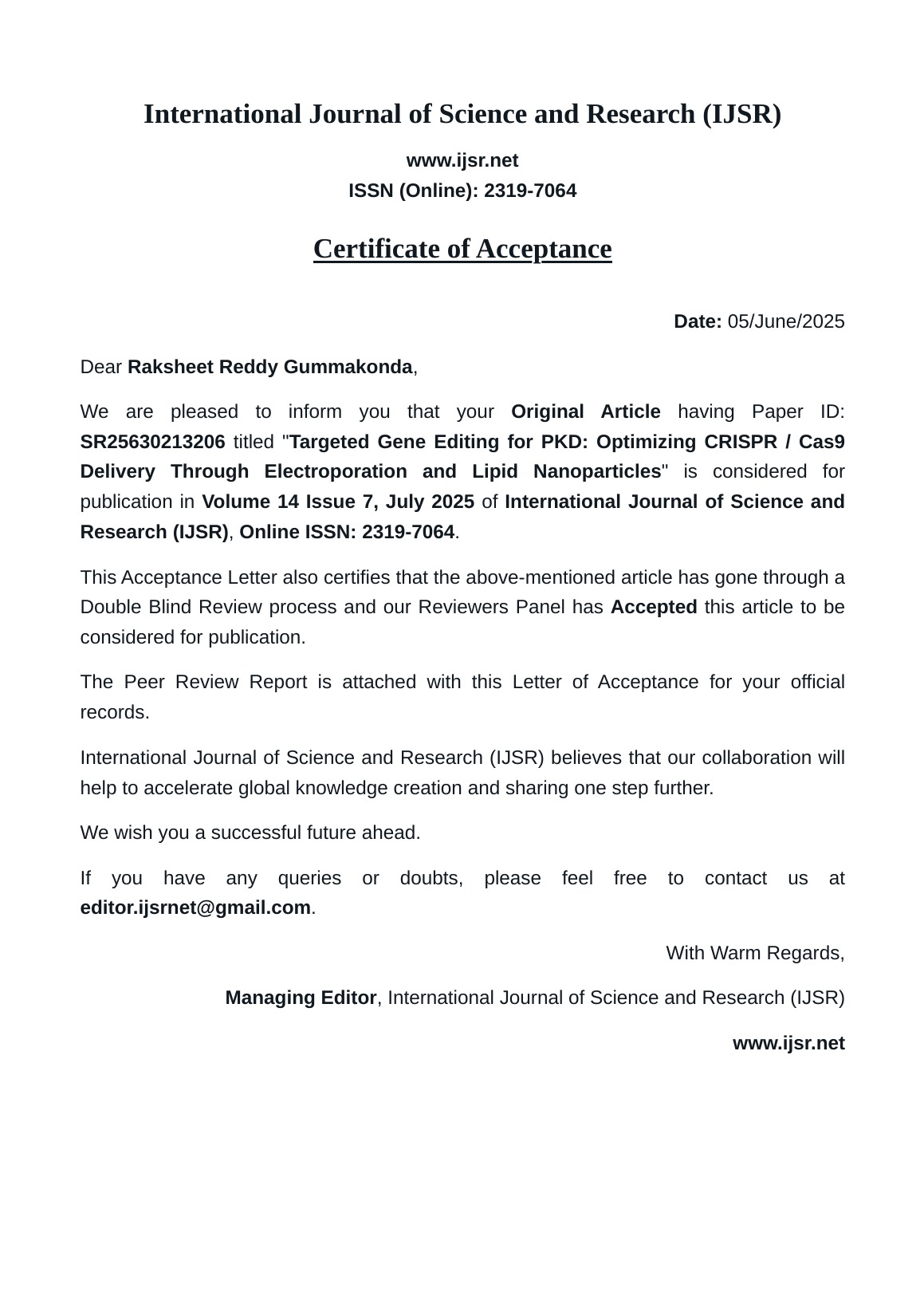
Independent research, published in the International Journal of Science and Research (IJSR).
Independent published research comparing delivery strategies for CRISPR/Cas9 editing in the context of polycystic kidney disease.
- Gene Editing
- Drug Delivery
- Independent Research

Problem
Current PKD treatments largely manage symptoms rather than the underlying genetic cause. Mutations in PKD1 and PKD2 disrupt polycystin function and drive renal cyst formation, while a major barrier to CRISPR/Cas9 therapy is delivering gene-editing components safely and selectively to kidney cells.
Research Approach
I developed a theoretical framework evaluating CRISPR/Cas9 correction of PKD1 and PKD2 mutations while comparing lipid nanoparticles and electroporation as delivery strategies. The analysis considered targeting precision, cellular uptake, off-target effects, tissue specificity, safety, and translational feasibility.
Electroporation vs Lipid Nanoparticles
LNPs can protect CRISPR cargo and support systemic, kidney-directed delivery, but require careful control of size, charge, biodistribution, immunogenicity, and toxicity. Electroporation enables efficient, localized delivery, particularly ex vivo, but is constrained by cell damage and limited whole-organ applicability. The paper also examines their potential complementary use.
Research Workflow
PKD1/PKD2 target analysis → sgRNA and PAM selection with off-target prediction → LNP formulation and electroporation parameter evaluation → kidney cell, organoid, and animal-model framework → NGS and computational assessment of editing precision → cyst burden, renal-function, safety, and ethical analysis.
Publication
International Journal of Science and Research (IJSR). DOI: 10.21275/SR25630213206.