Beyond Academics / Columbia Scientific Enrichment Month
Columbia Scientific Enrichment Month
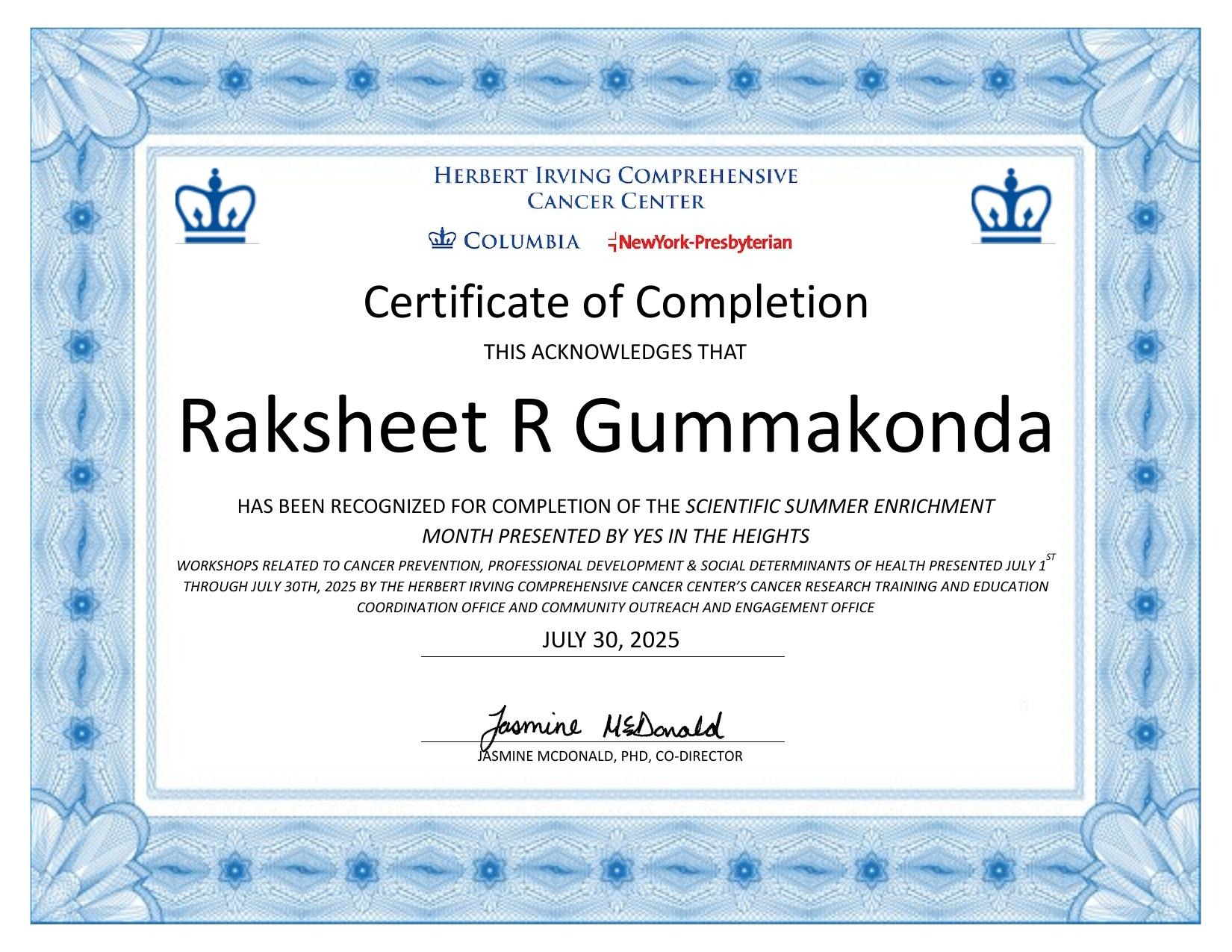
2025 Scientific Enrichment Month Participant
The 2025 Scientific Enrichment Month, organized by Columbia University’s Herbert Irving Comprehensive Cancer Center, was a month-long academic enrichment program exploring cancer biology, prevention, public health, health disparities, genetics, community engagement, and professional development.
Program Overview
Across live sessions and working-group presentations, I learned from Columbia faculty, physicians, researchers, public-health professionals, medical students, patient advocates, and specialists from partner institutions. The program helped me understand cancer not only as a biological disease, but also as a public-health, social, ethical, and community challenge.
Research & Scientific Inquiry
The scientific sessions exposed me to multiple areas of cancer research and prevention, including cancer genetics, genetic counseling, vaccines, skin cancer, physical activity, and risk reduction. I learned how different disciplines contribute to the same problem—from molecular genetics and clinical medicine to epidemiology and behavioral prevention. Sessions with physicians, epidemiologists, genetic counselors, and cancer researchers showed me how scientific questions move from biological mechanisms to prevention strategies and patient care.
Speakers included Ashley Stephens, MD, Assistant Professor of Pediatrics at Columbia University Irving Medical Center, on cancer prevention and vaccines; Larisa Geskin, MD, Professor of Dermatology at Columbia University Medical Center and Director of the Comprehensive Skin Cancer Center, on sun safety and skin cancer; and Rebecca Kehm, PhD, MPH, Assistant Professor of Epidemiology at Columbia Mailman School of Public Health, on physical activity and cancer.
I was also exposed to perspectives from Columbia medical students Alexander Kaminsky, Sararose Suhl, and Yoni Sacknovitz of the Vagelos College of Physicians and Surgeons during the skin-cancer session, giving me insight into how medical trainees engage with cancer education and prevention.
Public Health
One of the most important parts of SEM was seeing cancer through a public-health lens. The program began with cancer health disparities and inequities and later explored tobacco exposure, cancer risk reduction, immigrant health in New York City, physical activity, and the effects of cancer on patients and communities. These sessions showed me that preventing disease requires much more than developing treatments; it also requires understanding access, behavior, environment, communication, and the communities affected by disease.
This perspective was introduced by Jasmine A. McDonald, PhD, Assistant Professor of Epidemiology at Columbia University Mailman School of Public Health, who led sessions on cancer health disparities, the role of cancer centers, professional academic etiquette, and public speaking.
The immigrant-health panel included Dodi Meyer, MD, Professor of Pediatrics and Vice Chair of Community Health at Columbia University Medical Center, alongside physicians, nonprofit leaders, and youth advocates working directly with immigrant communities in New York City.
I also learned from Kimberly Burke, MPH, and Andria Reyes, MA, from the Office of Community Outreach and Engagement at the Herbert Irving Comprehensive Cancer Center during the Cancer Risk Reduction session.
Data & Society
The program approached data primarily through epidemiology, public health, and evidence-based decision-making rather than through a standalone data-science module. I saw how researchers use population-level evidence to understand disparities, identify risk factors, evaluate prevention strategies, and study how social conditions influence health outcomes. It helped me understand that scientific data has meaning only when it is interpreted within the lives and communities it represents.
Sessions on cancer disparities, physical activity, tobacco exposure, immigrant health, cancer prevention, and community outreach demonstrated how evidence can inform interventions and public-health decisions. This broadened the way I think about biomedical research: a laboratory result can explain a mechanism, but epidemiology and community data help determine whom a problem affects, why disparities exist, and how an intervention can create real-world impact.
Academic Experience
SEM also gave me exposure to the broader academic environment surrounding research and medicine. Beyond the scientific content, sessions covered professional academic etiquette, scientific communication, LinkedIn, storytelling, résumés and cover letters, public speaking, resilience in research, and undergraduate admissions. This made the experience feel less like a series of lectures and more like an introduction to how researchers, physicians, and students communicate, collaborate, develop professionally, and navigate academic careers.
Columbia-Affiliated Speakers
Among the Columbia-affiliated speakers I learned from were:
The program also brought in major researchers from other institutions, including Jedd Wolchok, MD, PhD, FAACR, FAIO, FASCO, Meyer Director of the Sandra and Edward Meyer Cancer Center at Weill Cornell Medicine, as well as genetic counselors from Huntsman Cancer Institute.
- Jasmine A. McDonald, PhD — Assistant Professor of Epidemiology, Columbia University Mailman School of Public Health.
- Mary Beth Terry, PhD — Professor of Epidemiology, Columbia University Mailman School of Public Health.
- Sandra Ryeom, PhD — Associate Professor of Surgery, Columbia University Vagelos College of Physicians and Surgeons, Columbia University Irving Medical Center.
- Juan Manuel Schvartzman, MD, PhD — Assistant Professor of Medicine, Columbia University Irving Medical Center.
- Aaron Viny, MD — Assistant Professor of Medicine, Columbia University Vagelos College of Physicians and Surgeons.
- Dodi Meyer, MD — Professor of Pediatrics and Vice Chair of Community Health, Columbia University Medical Center.
- Rebecca Kehm, PhD, MPH — Assistant Professor of Epidemiology, Columbia University Mailman School of Public Health.
- Ashley Stephens, MD — Assistant Professor of Pediatrics, Columbia University Irving Medical Center.
- Larisa Geskin, MD — Professor of Dermatology, Columbia University Medical Center; Director of the Comprehensive Skin Cancer Center, Division of Cutaneous Oncology.
- Henryne Tobias, EdM — Career Services, Columbia University Mailman School of Public Health.
- Chris Quach, MA — Associate Director of Undergraduate Admissions, Columbia University.
Key Takeaways
My biggest takeaway was how interdisciplinary cancer research really is. A single disease can require molecular biology, genetics, epidemiology, clinical medicine, prevention, behavioral science, community outreach, communication, and policy to understand it fully. The program showed me that impactful research is not only about discovering something new; it is also about making that knowledge understandable, accessible, and useful to the people it is meant to serve.
I also saw how academic careers develop through collaboration and resilience. The “Failure is the New Success” panel brought together researchers including Jedd Wolchok, Sandra Ryeom, Juan Manuel Schvartzman, Michelle C. Mendoza, and moderator Mary Beth Terry, reinforcing that scientific progress often comes through failed experiments, revised questions, and persistence rather than a perfectly linear path.
Reflection
Before SEM, I mainly thought about biomedical research from the perspective of the laboratory: identifying a biological problem, understanding its mechanism, and trying to develop a solution. Over the month, that view became much wider. Listening to epidemiologists, physicians, genetic counselors, researchers, patient advocates, medical students, and community-health leaders made me realize how many people and disciplines sit between a scientific discovery and meaningful improvement in human health.
What stayed with me most was the opportunity to learn directly from people working across Columbia’s medical and public-health community. Hearing how they approached cancer disparities, prevention, genetics, patient care, research failure, communication, and community engagement gave me a much clearer picture of what an academic career in biomedical science can look like. It made me more interested not only in doing research, but in understanding how that research reaches patients and communities.
The program concluded with participant working-group presentations on alternative tobacco products, cancer prevention and vaccines, sun safety and skin cancer, physical activity and cancer, and cancer genetics and genetic counseling, allowing the month’s learning to culminate in collaborative scientific communication.
Gallery / Documents
Certificate.